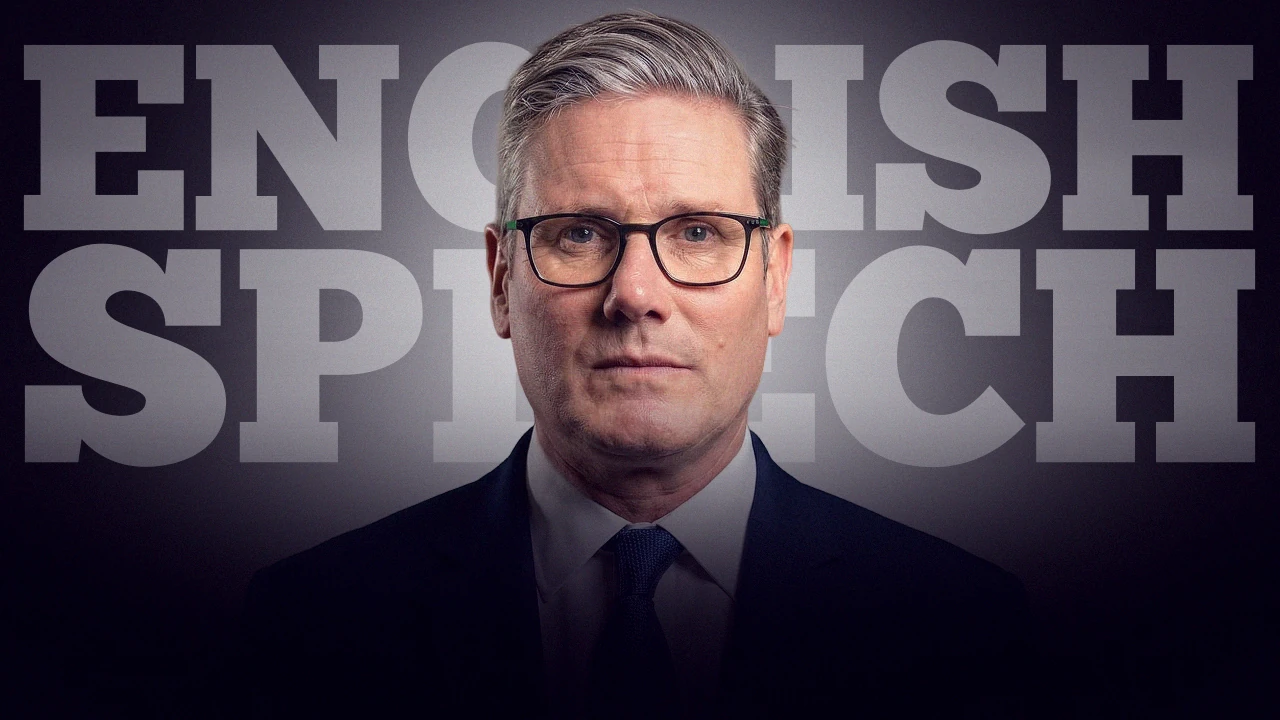


Learn English with Keir Starmer. In this 2026 press conference, the British prime minister explains how the Middle East war could affect energy prices, living costs, and national security at home. He calls for de-escalation, stronger European cooperation, and a more resilient British economy while arguing that Brexit damaged growth and left Britain more exposed to global shocks.
Who This Speech Is For
- Learners interested in politics, current events, and how leaders speak during international crises.
- Those who want useful vocabulary for energy, inflation, diplomacy, and national security.
- Intermediate to advanced learners studying calm, formal, persuasive British English.
How This Speech Helps Your English
- Learn formal public-speaking language used in press conferences and national updates.
- Expand vocabulary on war, shipping, energy security, cost of living, and EU cooperation.
- Observe how repetition, contrast, and reassurance make complex political ideas easier to follow.
- Notice how Starmer connects global events to everyday family concerns in clear, structured English.
Why This Speech Matters
- Shows how the Middle East war could affect daily life in Britain through fuel and energy prices.
- Explains why freedom of navigation in the Strait of Hormuz matters for the wider economy.
- Highlights Starmer’s argument that Brexit weakened Britain and that closer EU ties are now essential.

”Brexit left Britain exposed
Download available
for Plus Members
PDF Transcript
Access the full speech in an
easy-to-read PDF format.
Audio Version
Listen and download clear,
high-quality MP3 recordings.
English Lesson
Includes vocabulary
and grammar practice.
Offer ends in:
Offer ended.
Transcript
Good morning. The conflict in the Middle East has now entered a second month, and while we’re working at pace for de-escalation and peace, it is now clear that the impact of this war will affect the future of our country. So today I want to reassure the British people that no matter how fierce this storm, we are well-placed to weather it, and that we have a long-term plan to emerge from it a stronger and more secure nation. First, let me say once again, this is not our war.
We will not be drawn into the conflict. That is not in our national interest. And the most effective way we can support the cost of living in Britain is to push for de-escalation in the Middle East and a reopening of the Strait of Hormuz, which is such a vital route for energy. To that end, we’re exploring each and every diplomatic avenue that is available to us.
The Foreign Secretary and the Chancellor have met their counterparts in the G7. The Defense Secretary has been in the Middle East speaking to our partners. And the UK has now brought together 35 nations around our statement of intent to push as one for maritime security across the Gulf. And today I can announce that later this week, the foreign secretary will host a meeting that brings those nations together for the first time, where we will assess all viable diplomatic and political measures that we can take to restore freedom of navigation, guarantee the safety of trapped ships and seafarers, and resume the movement of vital commodities.
Following that meeting, we will also convene our military planners to look at how we can marshal our capabilities and make the strait accessible and safe after the fighting has stopped, because I do have to level with people on this. This will not be easy. I spoke with relevant business leaders in shipping, finance, insurance, and energy supply in Downing Street on Monday, and they were clear with me the primary challenge they face is not one of insurance, but one of safety and security of passage. So the fact is, we need all of this together, a united front of military strength and diplomatic activity, partnership with industry so they too can mobilize once the fighting has stopped.
And above all, clear and calm leadership. That is what this country is ready to provide, because my guide from the start of this conflict has always been the British national interest, and freedom of navigation in the Middle East is in the British national interest. Let me turn now to the impact at home, because I know that this is causing huge concern. People turn on their television, they look at their screens, they see explosions, infrastructure blown up, aggressive rhetoric.
They worry that the UK will be dragged into this. We won’t. But I also know that people have a deep sense that this will affect their family and their household. They can see it at the petrol pumps, and they worry about their energy bills.
It is the job of government to meet these moments, not just with immediate action, but also with clarity about our direction. That’s what I remember about the 1970s, when my family could not pay every bill. We struggled through the energy shocks and the price rises of that decade. But we always believed in the end that Britain would secure a better future for us, and I think that’s what’s been lacking in the crises of recent years.
And I’m not prepared to ask the British people once again to go through a crisis, come out of it and say, “Business as usual. Back to the status quo.” So on our economy, on our energy, and on our defense, this time will be different. We will make Britain a fairer and more secure country, because that hope is what is needed as the country comes together, and because how we emerge from this crisis will define us for a generation. So as I set out a few weeks ago, we have a five-point plan for the immediate crisis.
We’re cutting energy bills by over GBP100 per household today. We’ve extended the cut in fuel duty until September, and we’re monitoring that situation daily. We’re supporting people exposed to heating oil rises, setting aside GBP53 million for that. We’re taking back control of our energy security by investing in clean British energy, because that is the only way we get your bills off the rollercoaster that is controlled by Putin and the Iranian regime.
And frankly, I’m sick and tired of your energy bills fluctuating up and down because we’re on the international market, when if we took control of our energy and had homegrown renewables, we could stabilize your bills. And finally, as I say, we’ll continue to push for de-escalation in the Middle East. But look, there’s also a bigger argument here, because every one of these measures is part of a long-term plan to make our country more secure and more resilient to shocks like this. I mean, just look at what’s happening today.
Today, your energy bills will be cut because of the action that we took at the budget, and whatever happens in Iran, that price is now fixed until July. Today, if you need a prescription, instead of rising as they used to, the price will be frozen for a year. Today, if you’re working on the National Living Wage, your wages will go up. Next week on Monday, the state pension will go up.
Next week, the two-child limit will be scrapped, lifting four hundred and fifty thousand children out of poverty, the vast majority from working households. And next week, the biggest strengthening of workers’ rights in a generation will become law, a huge boost to the economic security of working people. Now, some people may say, “This isn’t new. This was already planned.” To which I say, yes, that is my point.
Everything I’ve done in politics, certainly since the Ukraine War in 2022, is a response to this new and dangerous world. We campaigned for a windfall tax on oil and gas companies, which we extended. We focused on the cost of living, and we acted at the budget. And we’ve always emphasized the need for clean British energy, and we’ve invested because we knew that making our country secure in this world was the ultimate test that we would face and our ultimate responsibility to the British people.
Now, it’s not going to be easy, clearly. And in the coming weeks, as you would expect, we will continue to assess the economic effects. We will continue to stand up for the British national interest, and we will continue to do what we must to guide our country calmly through this storm. However, it is increasingly clear that as the world continues down this volatile path, our long-term national interest requires closer partnership with our allies in Europe and with the European Union.
Now, we have made progress on this front, on agriculture, electricity, emissions trading, and more. But as the Chancellor has rightly pointed out, Brexit did deep damage to our economy, and the opportunities to strengthen our security and cut the cost of living are simply too big to ignore. So in the coming weeks, we will announce a new summit with our EU partners, and I can tell you that at that summit, the UK will not just ratify existing commitments made at last year’s summit. We want to be more ambitious.
Closer economic cooperation, closer security cooperation, a partnership that recognizes our shared values, our shared interests, and our shared future. A partnership for the dangerous world that we must navigate together. A world where this government will be guided at all times by the interests of the British people. Thank you.