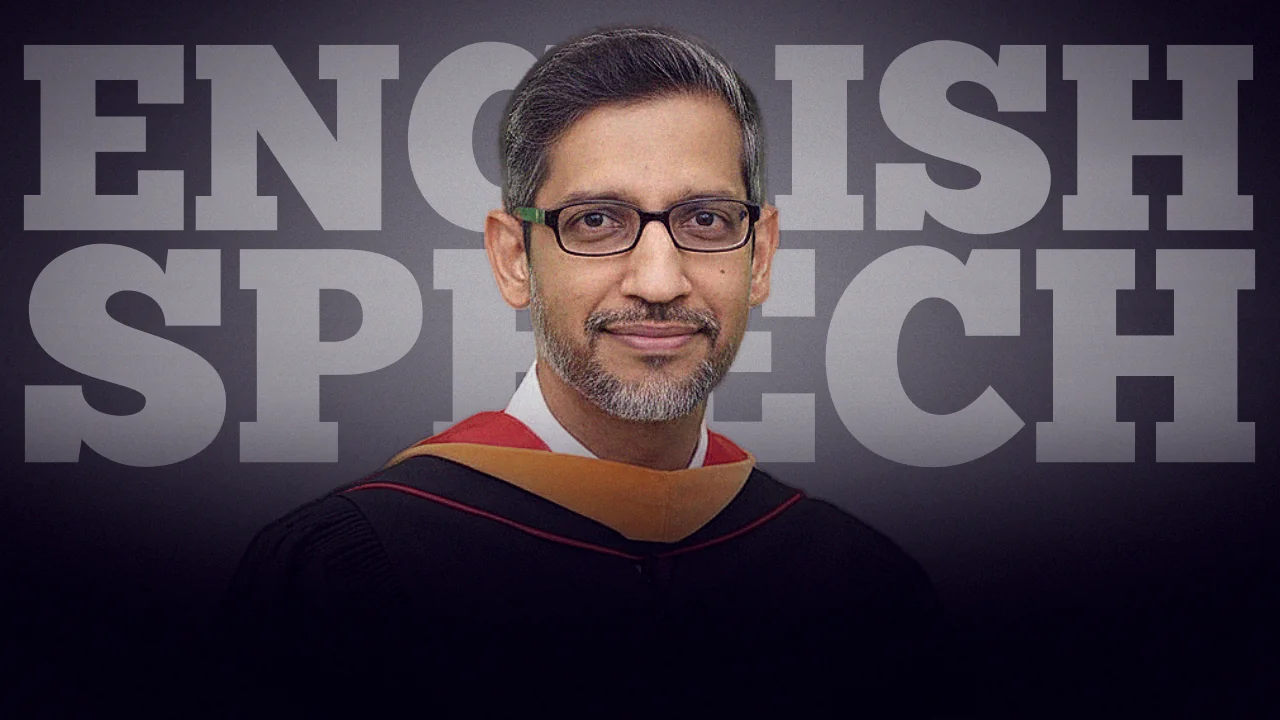


Learn English with Sundar Pichai. In this 2026 Stanford Commencement address, the Google and Alphabet CEO reflects on his journey from Chennai to Silicon Valley and shares three practical filters for life: choose optimism, work on hard things, and follow what excites you. Through stories about Stanford, Google Chrome, and access to technology, he encourages graduates to reframe challenges and say yes to meaningful opportunities.
Who This Speech Is For
- Learners interested in technology, leadership, graduation speeches, and personal growth.
- Students who want to discuss optimism, career choices, pressure, and meaningful work in clear English.
- Intermediate to advanced learners studying American English through storytelling, humor, and practical advice.
How This Speech Helps Your English
- Learn vocabulary about education, technology, career decisions, innovation, and resilience.
- Notice how a speaker uses personal stories to explain larger life lessons.
- Study phrases for giving advice, reframing problems, and encouraging an audience.
- Hear how humor, contrast, and short memorable lines can make a message more powerful.
Why This Speech Matters
- Encourages graduates to see uncertainty as part of growth rather than failure.
- Shows how optimism can change the way people interpret difficult circumstances.
- Connects access to technology with opportunity, progress, and human potential.
Download available
for Plus Members
PDF Transcript
Access the full speech in an
easy-to-read PDF format.
Audio Version
Listen and download clear,
high-quality MP3 recordings.
English Lesson
Includes vocabulary
and grammar practice.
Offer ends in:
Offer ended.
Transcript
President Levin. Provost Martinez. Trustees. Senior class presidents. Thank you for the invitation to address you today. And to the distinguished class of 2026, congratulations.
I must warn you all, this is only the second commencement speech I have ever given. The first was literally in my backyard. It was the spring of twenty twenty, right in the middle of COVID and lockdowns. We were filming a YouTube commencement for the graduates who could not have their own celebrations like this one.
When I look back on it, I see a time of great anxiety. I see the empty space where there should have been an audience. I see the haircut I gave myself right before filming. In fact, I really wish I could unsee it.
Today, what I see in front of me is how graduation should be: celebrating together and with the people you love who have supported you on your journey. Your parents, relatives, friends, professors, and everyone who helped you reach this milestone. Let us give them another round of applause. They deserve it.
I know not everyone you care about could be here. Many of you came from other parts of the country and the world, as I had, and it is not always possible for families to travel. In fact, this is the first time my mom and dad are attending a graduation ceremony I am a part of. So, let me say a special thanks to them and to my entire family here with me.
I know today is about giving you all advice, but people have also been giving me a lot of advice on what to say. Actually, it has been the same advice, and it is about what not to say. People thought it would be really difficult for me. The last two letters of my last name, after all.
In all honesty, the topic is truly immaterial to what I want to share with you. The most timeless advice I have learned is technology agnostic. It is about you, the life you want to build for yourself, and the choices that help you pursue that life.
Some of you know what you are pursuing already. Congratulations. Enjoy closing down the Rosencrown now. Gets tougher with a day job. Many of you may have absolutely no clue. That is okay too. I remember feeling uncertain on graduation day, the sense that life was a series of really big moments and the pressure I felt to get them all exactly right.
This is especially true for a group of high achievers who have sweated every grade, every paper, every exam, who are focused on having the right mix of activities, athletics, internships, and now your first jobs. I am going to let you in on a little secret. While these things matter in the moment, they are much less consequential than you might think. You could have failed that biology test, skipped a class, never learned to play the tuba, and you would still probably be here today.
Let me tell a story of how I started to learn this for myself. When I was a student here, I had a classmate named Pat. He was from Long Beach, had an earring in one ear, which I thought was really edgy at the time, and a white two-door Honda Prelude convertible. One Wednesday morning in January, my first winter quarter, we were on our way to class. He was like, do you want to go to Vegas instead?
I never skipped a class. I had never definitely taken a road trip before. In fact, this is the first time my parents are hearing of it. And yet I said, sure. So we went back to our dorm rooms, grabbed some things, and set off. You have to cut through the mountains to get there. As we drove through them, it started to snow. I had never seen snow before. I stuck my hand out to grab it. I could not believe the softness of the flurries. Pat stopped the car so I could get out. It was really beautiful, a moment I will never forget.
Nine hours from when we set out, we arrived in Vegas with the night lights on the horizon. I did not know what to think. Pat taught me how to play blackjack. I started with five dollars and did manage to win about fifteen more, and I was like, I am out. We did not have enough money to stay long, so the next day we started the drive back. No one seemed to notice that we had missed class. For the first time, I realized the world will not end if I relaxed a little.
You are going to face a lot of moments in your life. Only a few of them are really important, and you need to get them right: picking a partner, choosing whether to start a family, a bigger career pivot. Those decisions require time and intention. However, you will face many more moments in your life that only seem really big. Really big. Thousands of them, in fact, and very few of them are make-or-break.
Your first job out of college, the city you move to next, whether to take that road trip, while those moments add texture to your journey, they rarely determine the course of your life. But if you are able to filter the signal through the noise, you can nudge your life in these moments into having the impact you want.
So today I want to share three simple filters I have applied to my own life. Three filters that have helped me get more moments right than wrong and took some of the pressure off. First, choose optimism. This might not ring true to you at this moment. The world is going through a lot: global conflicts, economic anxiety, a rewiring of technology, information overload, all at a fast pace. It is easy to look at the news of the day and think that we are living in uniquely challenging times. For me, it is helpful to remember that each generation has faced hardship in their own way. We do not get to choose the world we graduate into, but we do get to choose how we frame our circumstances.
This was something my parents instilled in me at a young age. I grew up in the vibrant city of Chennai, India. It was a comfortable life for the most part, but in those early years, we had some challenges. We worried about severe drought and whether the water trucks would arrive in time. And for us, technology came slowly. We had to wait years to get a telephone, a TV, a refrigerator. Each changed our lives in meaningful ways. My parents never let the constraints limit my imagination of what was possible. It is the reason I even let myself dream I could one day work in a faraway place called Silicon Valley.
When the call from Stanford came, my father spent the equivalent of a year’s salary to buy my ticket. It was my first time on a plane. When I landed in California, it was not exactly as I had imagined. I remember that first drive down 280, coming from the airport with my host family. If you are not from here, California is advertised as being really lush and green. But when I looked out the window, it was more brown. I guess I said this out loud.
I am not sure why. My host, Mrs. Jane Earl, gently corrected me. We prefer to call it golden, she said. And that is exactly what I mean by choosing optimism. It is about reframing for the positive. Where I saw brown, she saw golden. This slight change of perspective had a huge ripple effect on how I thought about the world around me.
Lush forestry was not all that was misadvertised, if I am being honest. The ocean looks warm and inviting on the brochure. A Stanford professor even emailed me before I accepted and used the beautiful beaches as a selling point. So the first time I went to the beach in Santa Cruz, I ran fully into the water. It was not warm. I have since learned that the Atlantic can be warmer, which, by the way, is the only reason Stanford joining the ACC makes any sense at all.
Despite the brown hills and the cold ocean, it seemed like almost everyone I encountered had a generally positive outlook on life. Maybe it is because you can wear shorts all year. I do not know. I found myself adopting this California optimism. And it helped me navigate one of my bigger pivots during my time at Stanford. I came here fully intending to get my PhD and to move into academics. Life had other plans, and I needed to get a job sooner. So I left my doctorate program, and Stanford was generous to offer me the chance to fulfill the requirements for a master’s.
I could have seen it as the end of a dream, but thanks to Mrs. Earl, I was able to see that particular brown hill as golden. In that moment, I chose optimism.
The second filter is to gravitate toward working on hard things. I would love to tell you I was an immediate success after leaving Stanford. I was not. Even a decade later, I felt like I was not on the right path, and it took me a while to find my footing. Until I applied to Google. I had my final interview there in 2004. It was April Fool’s Day and the day Gmail launched. So when my interviewer asked me about it, I was not sure if it was a joke or a real product. That is because at the time, one gigabyte of free storage for everyone felt super ambitious and almost impossible.
A couple years into the job, I got my chance to work on a seemingly impossible problem too. It was around this time that the Internet was moving into a new phase. The Web was evolving from simple Web pages to rich applications. There was a group of us that felt we could reimagine the browser to be much better and faster, and we had an early prototype that we thought was pretty good. Internally, there was a consensus that building a browser would be incredibly difficult, requiring hundreds of engineers. We had a group of about ten. The consensus was right. It was going to be really hard.
In some ways, we were naive, and it is good to be a bit irrational when you approach new things. And in 2008, we launched what we thought was a great browser. We had eight million users in the first twenty-four hours, and the reviews were really positive, and then user growth stagnated. After a year, we had around two percent share. I remember Steve Ballmer, the CEO of Microsoft, made fun of Chrome in an interview and called it a rounding error. It could have been demoralizing, but with that California optimism, I told the team that the fact he went out of his way to dismiss us meant we were doing something right.
We kept going, setting highly aggressive stretch goals to keep the team pushing. We rapidly iterated, shipping the browser every six weeks, while others shipped one maybe every six months to a year.
Success began to follow. Working on hard things has taught me a lot. It typically attracts other great and optimistic people. And even if you miss meeting the high goals you set, you will still achieve something great. So when you have the choice to work on something hard, say yes.
And the third filter I use when all else is equal: do the thing that excites you. For me, there has always been access to technology. The more access my family had, the better our lives got. I did not have much access to a computer until I came to Stanford. So you can imagine my surprise when I walked into Sweet Hall and saw rows and rows of computers that I could use anytime I wanted.
It was 1993, and the internet was being built literally all around me. I saw it as a fundamental enabler of human progress. The idea that I could be a part of bringing it to as many people as possible was exciting. It is why I took the offer at Google, why I jumped at the chance to work on projects like Chromebooks and Android later on.
Several years ago, I remember meeting a group of women in rural India using Android smartphones for the first time to learn new trades, to speak with loved ones far away. And I remember visiting a classroom in Pittsburgh and seeing students from different backgrounds learning through the products I helped to build. Seeing computing change people’s lives, as it had changed mine, was the most exciting thing in the world to me.
So as you look at your own path, do not focus on the thing your parents want you to do, or the thing all your friends are doing, or that society expects of you. Instead, think about the things that keep you chatting excitedly with your roommate late into the night and go do those things.
Class of 2026, I genuinely believe you are the most capable class in history, at least until next year’s class. That is how progress works. You have thousands of moments ahead of you. The important thing is not to get them all right, it is to find a way to keep moving forward. Sometimes we end up somewhere wonderful, like a beautiful snow-capped mountain. Other times we end up in, well, Vegas. Both are a gift. You already have the California optimism to see life’s golden hills, and a Stanford diploma proving you can do hard things. Now go out and set your heart ablaze. Congratulations.