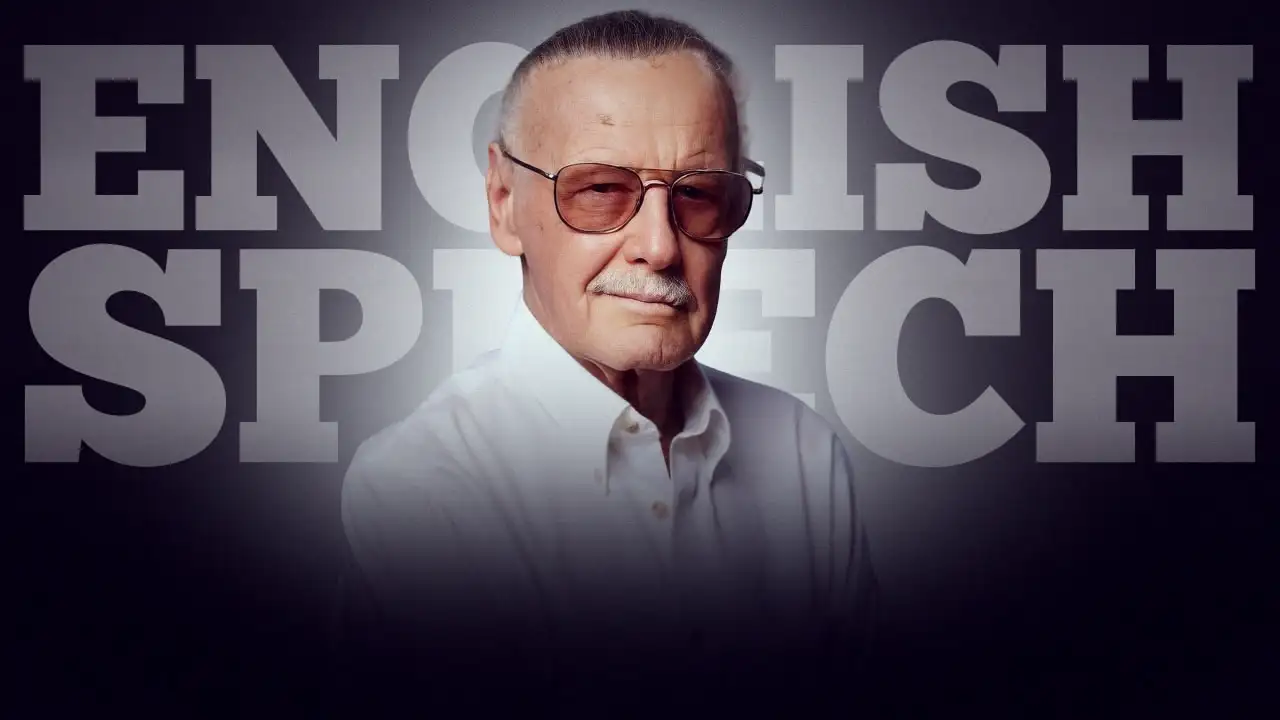


Learn English with Stan Lee. In his keynote address at the 2017 UCLA Extension Certificate Graduation Ceremony, delivered in 2018, the legendary creator of Marvel shares the true story behind Spider-Man. Through humour and honesty, Stan Lee reflects on creativity, rejection, perseverance, and believing in your ideas, offering timeless advice for students, creators, and dreamers everywhere.
Who This Speech Is For
Learners who enjoy story-driven speeches with humour and a clear message.
Creatives and entrepreneurs looking for motivation around ideas, rejection, and persistence.
Intermediate learners who want exposure to natural American spoken English.
How This Speech Helps Your English
Learn how to tell a story step by step using simple past tense and clear transitions.
Pick up everyday spoken expressions like “come up with,” “out of my system,” and “talk you out of it.”
Notice how repetition and short sentences help listeners follow ideas easily.
Practise understanding quoted dialogue, which is common in real conversations and storytelling.
Why This Speech Matters
Stan Lee shares the true origin story of Spider-Man, including how the idea was first rejected.
The speech highlights an important lesson: protect the ideas you genuinely believe in, while still using good judgment.
It shows that creative success often comes from persistence, even when others doubt your work.

”Believe in your ideas
Download available
for Plus Members
PDF Transcript
Access the full speech in an
easy-to-read PDF format.
Audio Version
Listen and download clear,
high-quality MP3 recordings.
English Lesson
Includes vocabulary
and grammar practice.
Offer ends in:
Offer ended.
Transcript
Host: Please join me in giving a big UCLA Extension welcome to our inaugural Icons of LA Award recipient, Mr. Stan Lee.
Stan Lee: Thank you. First of all, I hate Dean Smootz. He said my whole speech, all the things he said, I was gonna say. So I sit here before you, hopeless, worried, “What can I possibly do to make…” I didn’t really mean that, Dean.
I spent quite a lot of time writing a 25-page speech that I could give you, and as I looked at it, I said, “Would I want to hear this speech?” So I tore it up. So I stand here now, defenseless, with nothing except to tell you, I think you’re all great.
The fact that you’re taking the courses you’re taking, you’re trying to help, to add to what you already know, to make yourselves better workers, better contributors, and I think that’s great. I think, also, that I’m not gonna make a long speech, but I’m gonna tell you… I was told to say an anecdote.
Anecdotes are easy, so I thought to myself, “What kind of anecdote can I tell these people who really have more important things to do?” And I figured, “I’m gonna tell you how Spider-Man came into being.” It’s a true story, although sometimes it’s hard even for me to believe it.
We had already done the Fantastic Four and I think maybe the X-Men, I can’t remember the order, but my publisher came to me and he said, “Stan, I want you to come up with another superhero.” So I said, “Okay.” You know, went home, and when my publisher said, “Do something,” I’d better do it, because I wanted to keep my job.
I thought, “What can I come up with now?” And the most important thing in a superhero, at first, is the superpower. Once you get that, everything else comes along. So I thought, “What power will I give a new guy?” And I saw a fly crawling on the wall, and I said, “Hey, if I could get a superhero that could stick to walls and crawl on them, that would be cool.”
No, I’m lying to you. I don’t think the word “cool” was in use then. I probably said, “It’ll be groovy.” I’ll never lie to you.
So I thought that was good, now I needed a name. So I thought, “Well, let’s see.” Fly-Man. Mosquito Man. I got down to Spider-Man. Spider-Man. It just sounded dramatic.
So, okay, I had my hero. I had his power. I had his name. And then I figured, just for fun, I’m gonna give him personal problems, because, except for you people whose lives are perfect, most other people have personal problems.
And then I thought I’d make him a teenager, because there were no teenage superheroes that I knew of at the time. So armed with all that wonderful material, those great ideas, I ran into my publisher’s office and I told him.
This was the reaction he gave me. “Stan, that is the worst idea I have ever heard.” “First of all,” and he’s a very logical man, very intellectual, “First of all, people hate spiders, so you can’t call a hero Spider-Man. You want him to be a teenager? Teenagers can only be sidekicks. And you want him to have personal problems? Stan, don’t you know what a superhero is? They don’t have personal problems.”
Well, I left the office disappointed, but obviously a much wiser man. And I couldn’t get Spider-Man out of my system, so we were about to kill a magazine, I think it was called Amazing Fantasy. It wasn’t selling well, and we were sending the last issue to press.
When you do the last issue of a magazine, nobody cares what you put in it, because the book is dying. Just to get it out of my system, I put Spider-Man in Amazing Fantasy, featured him on the cover, and forgot about it.
A month later, all the sales figures came in. My publisher came racing into my office. “Stan! Stan! You remember that character we both loved so much, Spider-Man?” “Let’s do him as a series.”
Now, why am I telling you this, besides the fact that I have to kill a little time? If you have an idea that you genuinely think is good, don’t let some idiot talk you out of it. Now, that doesn’t mean that every wild notion you come up with is gonna be genius.
But if there is something that you feel is good, something you want to do, something that means something to you, try to do it. Because I think you can only do your best work if you’re doing what you want to do, and if you’re doing it the way you think it should be done, and if you can take pride in it after you’ve done it.
No matter what it is, if you can look at it and say, “I did that and I think it’s pretty damn good,” that’s a great feeling. So don’t let idiots talk you out of something that you think is good.
By the same token, that doesn’t mean every single thing you think is good is gonna win a prize. You’ve got to have a little judgment there. I’ve had other things that I thought were good that didn’t work, but I’ll save that for the next award you give me. I’ll need something to tell you by then.
And I want to say, I cannot tell you how much I appreciate this award, and this college has meant a lot to me. I have spoken here many times over the years. It’s one of the great institutes of learning, and to get this award, the Icon Award, I am truly touched.
So I want to thank the staff and whoever it is that gave it to me. And I want to wish all of you the best luck in the world. Just do your thing. Do it as well as you can. That’s the important thing.
Don’t shirk. Whatever you do, give it your best shot. You’ll be glad you did. Excelsior!